Price note: Unless explicitly identified as an officially checked fare, amounts below are planning estimates retained from the archive. They are not live quotes. Confirm the final price for your date, branch and party size.
⚡ Quick answer
- Getting there: compare KTX departures and fares for your date. Allow station transfers as well as the train journey; flights or buses may suit some routes better.
- How long you need: two to three days minimum. Busan's sights are spread across a wide coastline — this is not a city you can speed-run in a day.
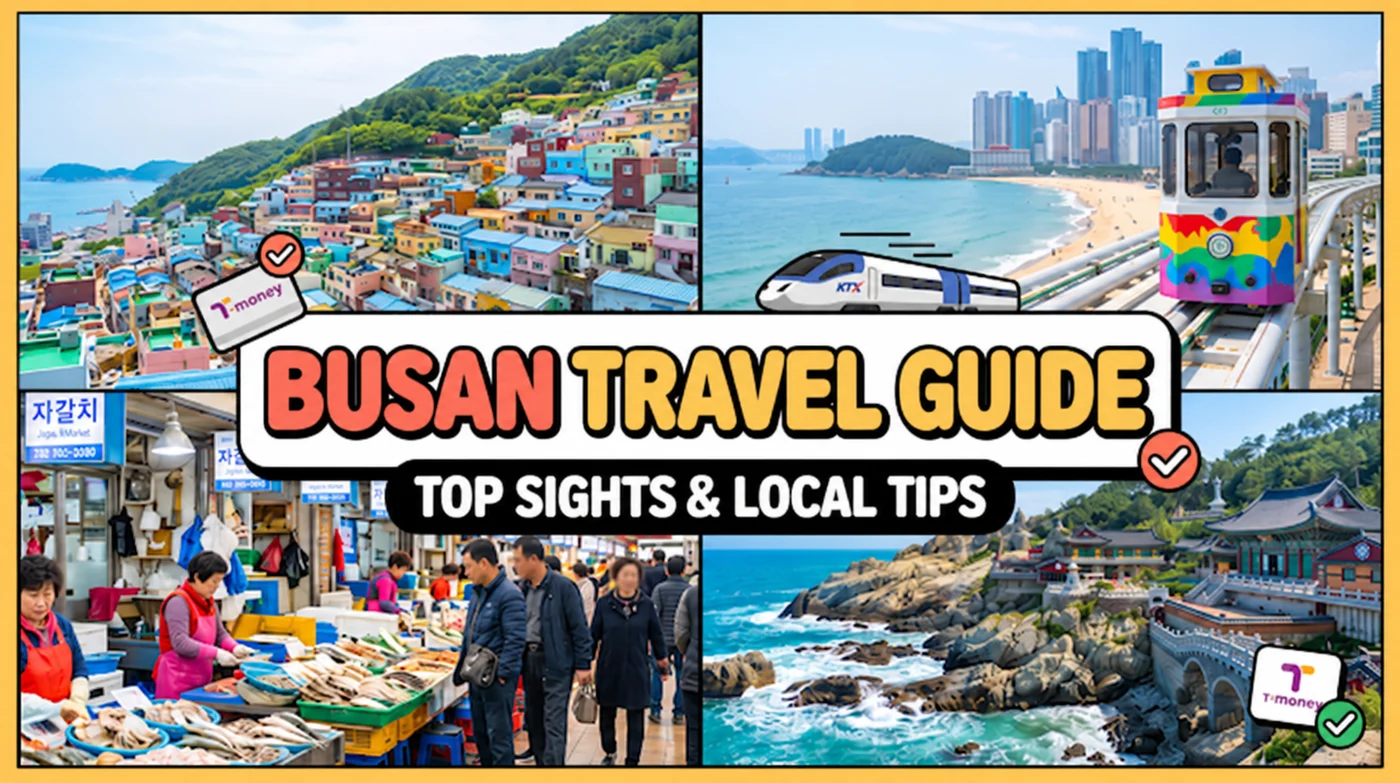
- The four essentials: Gamcheon Culture Village, Jagalchi Fish Market, Haedong Yonggungsa Temple, and the Haeundae coastline.
- Book the Sky Capsule weeks ahead. Sunset slots sell out two to four weeks in advance, and the price is per capsule, not per person.
- Where to stay: Seomyeon for transit convenience, Haeundae for the beach, Nampo-dong for markets and old Busan.
- Your T-money card works on Busan's subway and buses. No new card needed.
Seoul is extraordinary, but Busan has something Seoul does not: the ocean, and a completely different temperament because of it. Korea's second city is a working port wrapped around beaches and mountains, where a cliffside temple sits forty minutes from a fish market that has been trading since before the Korean War, and where the pace drops noticeably the moment you step off the train.
Busan Tourism figures put food as the primary draw for a large majority of international visitors, and that tracks. But the city rewards a slower kind of travel than Seoul does. This guide covers how to get there, how to structure your days by district, what genuinely deserves your time, and the practical details — including one ticketing trap that catches a lot of solo travelers.
Getting from Seoul to Busan
Three options, and one of them is clearly best for most people.
| Option | Time | Cost (one way) | Verdict |
|---|---|---|---|
| KTX (high-speed rail) | 2h 15m–3h | ~₩59,800 economy reserved | The right answer for almost everyone |
| SRT | ~2h 30m | Similar to KTX | Better if you're staying near Gangnam — departs Suseo Station |
| Express bus | 4h 30m+ | ~₩25,000–30,000 | Only for tight budgets or overnight departures |
| Flight | ~1h in the air | Varies | Skip it. Airport transfers erase the time saving. |
The KTX runs from Seoul Station and drops you at Busan Station, which is downtown — no transfer, no airport. Over 70 trains a day means you rarely need to plan around the schedule, though tickets open one month before departure and popular weekend slots do fill.
Book through Korail’s official international booking service or an authorised seller. Select the appropriate overseas-card option where offered, check the final price and save the reservation. Card approval and third-party fees vary.
Is the KR Pass worth it?
Compare the current Korail Pass price with the individual trains you plan to take. A Seoul–Busan return trip does not automatically make a pass worthwhile.
Check pass eligibility, permitted trains, seat reservations and activation rules before buying. Do not assume that all Korean rail operators are covered.
Understanding Busan's Geography (This Matters)
Seoul is dense and radial. Busan is long, coastal, and mountainous, and its highlights sit at opposite ends of the city. Gamcheon in the west and Haedong Yonggungsa in the far east are close to an hour apart on public transport. Trying to do both plus a beach in one day means spending most of that day on a bus.
The practical fix is to group your days by district. Here is how the city divides:
| District | What's there | Time needed |
|---|---|---|
| Nampo-dong / Jagalchi (downtown west) | Jagalchi Fish Market, Gukje Market, BIFF Square, Busan Tower | Half day |
| Gamcheon (western hills) | Gamcheon Culture Village | 2–3 hours |
| Yeongdo (island, south) | Huinnyeoul Culture Village, Taejongdae | Half day |
| Haeundae (east coast) | Haeundae Beach, Blueline Park, BUSAN X the SKY | Full day |
| Gwangalli (between center and Haeundae) | Gwangan Bridge views, beach cafes, nightlife | Evening |
| Gijang (far northeast coast) | Haedong Yonggungsa Temple | Half day |
| Seomyeon (center) | Transit hub, food, shopping, nightlife | Evening / base |
Pair the west side (Gamcheon + Nampo-dong + Jagalchi) on one day, and the east coast (Yonggungsa + Blueline Park + Haeundae) on another. That single decision saves you hours.
The Essentials: What Actually Deserves Your Time
Gamcheon Culture Village
A hillside of pastel houses stacked in terraces above the harbor, originally settled by Korean War refugees and later transformed by an art regeneration project. It is Busan's most photographed place and unavoidably crowded, but the scale of it — layers of color climbing the slope — still lands.
Walking around is free. There are small paid exhibits and a stamp-trail map you can buy, but you do not need either. Wear shoes you can climb in; the village is genuinely steep. Go early morning if you want photographs without crowds in them, and remember that people live here — the alleys are residential.
Jagalchi Fish Market
Korea's largest seafood market, and the most sensory hour you will spend in Busan. The system is straightforward: choose your seafood from the tanks on the ground floor, and the vendor sends it upstairs to be prepared while you take a table. Live octopus, sea urchin, raw fish, grilled shellfish — whatever you point at.
Prices are negotiable and rarely posted, so agree on the number before anything is cooked. Bring cash. The surrounding streets connect straight into Gukje Market and BIFF Square, which is where the Busan International Film Festival's street food culture lives — ssiat hotteok, the seed-stuffed pancake, is a Busan speciality worth queuing for.
Haedong Yonggungsa Temple
Most Korean temples sit in mountains. This one sits on rocks above the sea on the northeastern coast, and the contrast — painted eaves, crashing surf — is why it appears on every Busan list. Go in the morning, both for the light and because it gets busy by midday.
It is free to enter but takes roughly an hour each way from central Busan by bus or a subway-plus-bus combination. Budget it as a half day and pair it with the Haeundae side of the city rather than trying to squeeze it around western sights.
Haeundae Blueline Park — and the ticketing trap
Haeundae Blueline Park has two different rides: the Beach Train and the Sky Capsule. Choose the route, ticket and departure station carefully; they are not interchangeable products.
| Sky Capsule | Beach Train | |
|---|---|---|
| What it is | Elevated pastel capsule, 7–10m above the coast | Ground-level train along the shoreline |
| Capacity | Up to 4 people per capsule | Open carriages, shared |
| Duration | ~30 minutes, slow | Shorter, more stops |
| Booking | Essential — sells out weeks ahead | Usually available same day |
| Price checked October 4, 2026 | ₩50,000 / ₩55,000 / ₩60,000 for 2 / 3 / 4 people per capsule | Separate per-person tickets; see operator fare table |
⚠ The Sky Capsule is priced per capsule, not per person. A capsule holds four. If you are traveling as a couple or a group of four, the per-head cost is reasonable. If you are solo, you are paying the full capsule fare for yourself — and plenty of listings quote the number without making that clear. Solo travelers often find that joining a day tour that includes a guaranteed Sky Capsule seat works out better, since the operator fills the capsule.
Book at least a week ahead, and two to four weeks for sunset slots, which always go first. A good local strategy: ride one way and walk back along the parallel coastal trail rather than paying for a return. The walk is the nicer half.
Gwangalli Beach and the bridge
Haeundae is the famous beach; Gwangalli is the better evening. The beach faces the Gwangan Bridge, which is lit after dark, and the strip behind it is solid cafes and bars. On scheduled nights there are drone shows over the water. If you want one memorable Busan evening without planning anything, this is it.
Worth It If You Have Time
Huinnyeoul Culture Village on Yeongdo island — white houses and blue roofs above the sea, frequently compared to a Greek island. Smaller and much quieter than Gamcheon, with a cliffside path along the water.
Taejongdae — a forested headland at the southern tip of Yeongdo, with sea cliffs and a lighthouse. There is a danubi shuttle train if you do not want to walk the loop.
BUSAN X the SKY — observation deck near Haeundae with a Starbucks near the top, one of the highest in the world. Best at night. Skip if you have already done N Seoul Tower and are not a view person; the windows can be reflective for photos.
Beomeosa Temple — a large mountain temple in the north of the city, and the antidote to the crowds. Very different in feel from Yonggungsa.
Sajik Stadium — if the Lotte Giants are playing, Korean baseball is a genuine cultural experience and Busan's fans are the loudest in the league. Cheap tickets, organized chanting, and you can bring your own food and beer in.
Is the Visit Busan Pass Worth It? An Honest Answer
The official VISIT BUSAN PASS product list checked on 4 October 2026 lists the 24-hour pass at ₩55,000 and the 48-hour pass at ₩85,000. Time starts with the first included attraction visit. The mobile pass does not function as a public-transport card. Check the current attraction list and reservation conditions before buying.
Whether it pays off comes down to one question: how many paid attractions will you actually visit, and how fast?
Add up only the attractions you will actually visit within the pass conditions. Compare that total with the product price at checkout, including any reservation or supplement requirements.
A pass may offer little value for a beach-and-neighborhood itinerary with few paid attractions. Build your own admission total instead of buying a pass on the assumption that every Busan itinerary saves money.
The honest recommendation: buy it only if you have deliberately planned a paid-attraction-heavy day. Do not buy it as general insurance. And check the current inclusion list at the point of purchase rather than trusting an article, since the contents change between editions.
Where to Stay
| Area | Best for | Trade-off |
|---|---|---|
| Seomyeon | First-timers. Central subway interchange, so everything is one transfer away. Best food and nightlife density. | No ocean view, no beach |
| Haeundae | Beach mornings, resort hotels, Blueline Park on your doorstep | Far east — long trips to Gamcheon and Nampo-dong |
| Nampo-dong | Markets, old Busan character, harbor views, walkable to Jagalchi | Older hotel stock, quieter at night |
| Gwangalli | Bridge views, cafe culture, good middle ground between east and center | Fewer budget options |
| Near Busan Station | Short trips, early KTX departures | The area itself is unremarkable |
For a first visit of two or three nights, Seomyeon is the safe choice — being at the interchange saves more time than a sea view is worth. For four nights or more, splitting between Seomyeon and Haeundae works well.
Getting Around Busan
Your T-money card works here. Busan's subway, city buses, and taxis all take it, so there is nothing new to buy if you already have one from Seoul. The local Cashbee card exists and works identically; you do not need both.
The subway is clean, signed in English, and covers most of what you want — but not everything. Haedong Yonggungsa and parts of Gijang need a bus connection, and Gamcheon requires a short bus or taxi up the hill from the nearest station. Taxis are inexpensive by Seoul standards and worth taking for the hill climbs.
Use a current navigation app such as Naver Map or KakaoMap for the route and bus direction. App features differ; the previous claim that Google Maps has no useful Korean transit navigation was too broad.
What to Eat in Busan
Busan's food is distinct from Seoul's, and not just because of the seafood. The city's Korean War refugee history produced dishes you will not find done as well anywhere else.
- Dwaeji gukbap — pork and rice soup, Busan's signature dish and its great contribution to Korean comfort food. There are entire streets of specialists.
- Milmyeon — cold wheat noodles, invented here when refugees substituted wheat flour for buckwheat. Summer food.
- Eomuk — Busan fish cake, taken far more seriously here than the street-stall version elsewhere. Try a proper eomuk bakery.
- Ssiat hotteok — the BIFF Square pancake, stuffed with seeds after frying.
- Raw fish at Jagalchi — pick from the tank, eat upstairs.
- Sea urchin gimbap — a Yeongdo speciality associated with the haenyeo diving communities.
How Many Days, and When to Go
Two days covers the essentials if you are disciplined: west side one day, east side the other. Three days is the comfortable minimum and lets you add Yeongdo or Beomeosa. Four or five days opens up a Gyeongju day trip, hiking, or simply slowing down, which is what the city is actually good at.
On timing: Busan's beach season runs roughly May through September, and summer is when the city is at its most alive — also its most crowded and humid. Spring and autumn are more comfortable for walking, and autumn in particular pairs clear coastal light with reasonable temperatures. Winter is mild by Korean standards but the beaches lose their point. Late spring is arguably the sweet spot.
Frequently Asked Questions
How many days do I need in Busan?
Two days covers the main highlights if you group them by district — Gamcheon and Jagalchi on the west side one day, Haedong Yonggungsa and Haeundae on the east the next. Three days is more comfortable and allows Yeongdo island or Beomeosa Temple. Four or five days lets you add a Gyeongju day trip or simply travel at Busan's natural pace.
Is Busan worth visiting if I only have a week in Korea?
Yes, if you are willing to give it at least two nights. Busan and Seoul are genuinely different cities rather than variations on a theme — coastal, slower, with its own food culture. What does not work is a Busan day trip from Seoul; five hours of round-trip rail for a few hours on the ground wastes both the money and the city.
Does my T-money card work in Busan?
Yes. T-money is accepted on Busan's subway, city buses, and taxis, so there is nothing extra to buy if you already have one from Seoul. The local Cashbee card works the same way, but you do not need both. Note that T-money does not cover the KTX — that requires a separate ticket.
Why won't the Korail website accept my credit card for KTX tickets?
Foreign-issued cards are frequently rejected by the Korail website. Try the KorailTalk app instead, which travelers report works more reliably, and choose the "issued overseas" option at payment. If it still fails, book through a third-party platform for a small markup, or simply buy at a station counter once you are in Korea.
How much does the Sky Capsule cost, and do I need to book ahead?
The current official one-way capsule table lists ₩50,000 for two people, ₩55,000 for three and ₩60,000 for four. The fare varies by party size; it is not one flat starting price for any group up to four. Check availability and the operator’s child policy before booking.
Is the Visit Busan Pass worth buying?
Only if you are deliberately packing several paid attractions into a single day. Most of Busan's best experiences — Gamcheon Culture Village, Jagalchi Market, Haedong Yonggungsa, every beach, the coastal trails — are free to visit. Travelers spreading a few paid sites across several days generally do not reach the break-even point.
What food is Busan actually known for?
Dwaeji gukbap, a pork and rice soup that is the city's signature dish, and milmyeon, cold wheat noodles created by Korean War refugees. Busan-style eomuk fish cake is taken far more seriously here than elsewhere, and ssiat hotteok at BIFF Square is a local street food institution. Seafood at Jagalchi Market is the headline, but the refugee-era dishes are what make the city distinct.