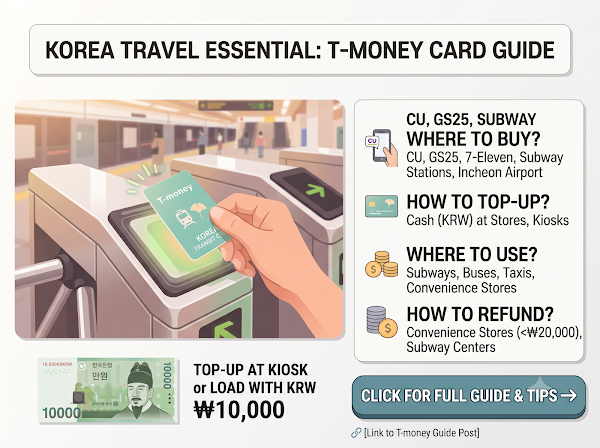
Quick answer: Tmoney is a rechargeable payment option for participating local transit. It is useful, but not the only way to ride: other accepted transit cards and single-journey tickets also exist.
Buying and loading a physical card
Ask at a participating convenience store or transit sales point for a standard Tmoney card. Designs, stock and card prices vary. The purchase price is separate from travel credit, so ask what balance is included before you leave the counter.
Keep won for ordinary physical-card top-ups. Load a modest amount based on your actual route, check your balance after travel, and top up again when needed. The previous blanket claim that new Seoul machines recharge all Tmoney cards using foreign credit cards was incorrect.
What changed at Seoul subway machines?
The March 2026 foreign-card upgrade concerns single-journey tickets and short-term Climate Cards. Choose the correct product on the machine; it is not a general promise of foreign-card Tmoney recharging.
Using an iPhone
Tmoney arrived in Apple Wallet in July 2025. For overseas-card top-ups through Mobile Tmoney, the developer's July 2026 notes list Mastercard, American Express, UnionPay and JCB. Review the app's current eligibility and fee screen before paying. We do not promise a future Visa launch or identical Android support.
On buses and subways
Use the same card when entering and leaving. Tap off the bus as well as on: the exit record matters for distance charging and eligible transfers. Keep the card separate from other contactless cards so the reader knows which one to charge.
Seoul's standard adult subway base fare using a transit card is ₩1,550. Distance, route and special-line charges can add to it. Transfer discounts have conditions; a transfer is not automatically free. Intercity trains such as KTX and ITX require their own tickets.
Tmoney or Climate Card?
Tmoney is pay-as-you-go. The Climate Card is a pass with a defined coverage area, validity period and exclusions. Compare your actual journeys with Seoul's current official coverage map before choosing it, especially for airport or out-of-city travel. Do not assume that all transport in the Seoul metropolitan area is included.
Getting unused credit back
Refund channels and balance limits depend on the card and sales point. Ask the provider or a staffed counter before loading a large amount. Physical and mobile cards may use different procedures; the card purchase price is not the same thing as unused travel credit. We removed the unverified claim that any convenience store can refund every eligible balance.
Leave time to handle refunds before airport security. Keep the card or app available until the refund is confirmed, and check whether any fee makes it more practical to use the remaining balance on an accepted purchase.
Plan the next step
Seoul Climate Card for Tourists: Is a Short-Term Pass Worth It?