What to do with a cup, food container or full bag of rubbish—and why your accommodation’s instructions matter more than a generic sorting chart.
For rubbish while you are out
Use a clearly marked public or customer bin where one is provided. If you cannot find one, close or wrap the item and carry it until you reach an appropriate bin at your accommodation or another facility that accepts it. Do not leave a cup beside a full bin, on a station platform, in a bicycle basket or outside a shop.
A business’s bin is not automatically a public disposal point. If you bought the item there, follow the shop’s return and sorting area; otherwise, ask before using its bin. Pouring a drink into a planter, street drain or toilet is not a disposal method.
At a hotel, guesthouse or rental
Ask the host or front desk where each type of waste goes and when it can be placed there. Seoul’s official foreign-resident guidance says ordinary waste uses designated pay-as-you-throw bags, food waste uses a dedicated bag or collection container, and recyclables are separated. It also warns that the method can differ by district and housing type.
That local variation is why a random online chart should not override the instructions for your building. A hotel may collect mixed room waste and sort it through its own system; a rental may require the guest to use labelled containers or district bags. Follow the arrangement for the property rather than copying what you see outside a neighboring building.
A simple decision order
- Is there food or liquid left? Empty the item only where the accommodation or facility tells you to do so.
- Is the item accepted as recycling here? Check the label on the bin and the local instructions.
- Can separate parts be removed? Separate a cap, label or other component only when the posted system requests it.
- Still unsure? Ask staff instead of contaminating a recycling container.
Common recycling groups in Seoul guidance include paper, plastic, cans, glass bottles and plastic film, but acceptance depends on the material and its condition. A food-stained package, multi-material pouch or disposable cup is not automatically recyclable because it looks like paper or plastic.
Takeout cups and convenience-store meals
Finish or drain liquids at an approved collection point. Keep leftover food separate from packaging when the facility provides a food-waste route. Do not put chopsticks, wet wipes, receipts and half-full drink cups together into a recycling opening.
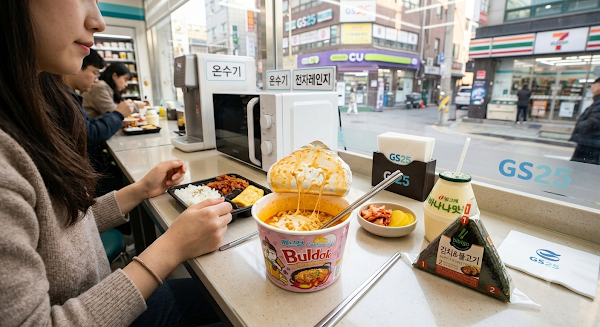
If a convenience store has a customer sorting station, read the labels and use it for waste from that store. Staff can tell you where to put leftover liquid or food. Our convenience-store food guide can help you buy a manageable meal instead of opening several items you may not finish.
Bottles, cans and unfamiliar packaging
Empty containers and follow the bin categories at the location. Seoul and national guidance may require transparent beverage bottles to be separated from other plastics in residential collection. Do not assume the same opening exists in a station or tourist venue; use the categories actually provided.
For an unusual household item, Korea’s Ministry of Environment points residents to the Household Waste Separation and Disposal website, which covers many item types and nearby collection points. The service is most useful for longer stays; your host or district remains the practical contact for the exact building.
Batteries, medicines and hazardous items
Do not put batteries, medicines, fluorescent lamps, gas canisters or electronics into an ordinary visitor bin. These can have dedicated collection routes. Ask the accommodation, pharmacy, retailer or district office which authorized point accepts the exact item. Do not abandon a damaged battery or pressurized container in a room.
Before checkout
- Clear the refrigerator and ask where food waste belongs.
- Separate only according to the property’s instructions.
- Do not leave a large bag in a corridor or on the street.
- Ask about bulky packaging or damaged luggage rather than placing it beside a bin.
If you are moving between cities, dispose of normal travel waste before boarding and keep essentials organized using our luggage-storage checklist. For payment at stores, see how to pay in Korea.
This article was checked for Seoul on 8 October 2026. It does not replace a district schedule, property rule or bin label. When they differ, follow the current instructions at your accommodation and disposal point.